Nationally Famous Speakers Heard and big Parades Held
By James Hart
Like in so many other places in North America, March 17 in Bloomington belonged to the Irish. In 1938 Pantagraph writer James Hart told of the low-key celebration that year, but also shared tales of 19th Century celebrations, rich with names of Bloomington’s Irish folks and societies. An edited, sometimes paraphrased, version of his article follows.
St. Patrick’s Day is here again. The occasion reawakens fond memories of the “old sod” of Ireland in Bloomington. They will celebrate the anniversary of Erin’s patron saint quietly by wearing a bit of green shamrock and by listening to familiar Irish airs.
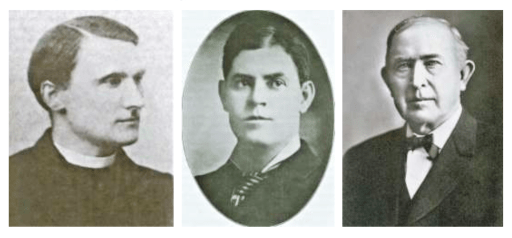
Rev. J. J. Burke, James O’Donnell, and Mayor James Costello.
Three photos, courtesy McLean County Museum of History.
But many local residents will recall some of the celebrations of older days, when Irish organizations here were accustomed to doing things on a grand scale. Old timers tell of the great parades of the 1870s and 80s, when the annual procession on March 17 was led by the Hibernian Rifles, a semi military company of young men in the city, with the two divisions of the Ancient Order of Hibernians and the Knights of Father Matthew also in line.
Marshals Wear Stovepipes
The procession usually formed on Chestnut Street, which was then the busy center of west side activities, and swung into Main with the bands blaring “The Wearin’ of the Green.” A marshal or two rode on horseback at the head, conspicuous for their stovepipe hats and bright green sashes draped over their shoulders.
The names of O’Brien, Keating, J. F. Reagan, Luke Nevin, William Condon, Thomas Campbell, William and Daniel O’Neill, Patrick Dixon and James Costello (afterwards mayor of Bloomington) are recalled as among the more active ones. James Sweeney of 919 North Lee Street was a captain in the rifles, and still retains his soldierly bearing. Edmund O’Connell, veteran attorney, and Michael Leary are perhaps the oldest surviving contemporaries of those men of the 70s.
Rifles Disbanded
The Hibernian Rifles disbanded during Governor Cullom’s administration, and the annual parades were discontinued about that time. Thereafter the Ancient Order of Hibernians began its series of annual indoor celebrations, which ceased about ten years ago, when death had removed virtually all the leading spirits from the scene.
With the founding of St. Patrick’s parish in 1892, Father J. J. Burke began the custom of celebrating high mass on St, Patrick’s Day, which the Irish societies attended in a body. This practice was continued by his successor, Father O’Callaghan. In the early 1890’s the occasion would be climaxed by a grand ball in the evening, following a public gathering held in the Coliseum, for which noted orators were brought to the city.
Bryan Brought Here
Most memorable was that of 1900, which was addressed by William Jennings Bryan, then at the height of his fame. The following year the speaker was Maude Gonne, Ireland’s beautiful “Joan of Arc.” Major John McBride, fresh from his laurels in the Boer War, also spoke. He was one of the patriot leaders executed by the British after the Dublin uprising of 1916.
Chicago Mayors Speak
In the second decade of the twentieth century, St. Patrick’s Days saw festive banquets at the Illinois Hotel, with musical program(s) by local talent and addresses by nationally known speakers. Among those who appeared were Congressman Perry Belmont of New York; Senator James Hamilton Lewis; Governor Edward F. Dunne; Mayors Carter H. Harrison and William E. Dever of Chicago; Father Carroll, president of Notre Dame University; Lawrence Stringer and Roger C. Sullivan.
In those years these oratorical fests of March 17 were the most elaborate affairs of the kind in Illinois outside of Chicago. Their success was largely due to the efforts of James F. O’Donnell, one of the publishers of the Bulletin, whose wide acquaintance among public men always assured that an outstanding spellbinder would be here.
Many Hibernians Help
“Jimmie” O’Donnell was unquestionably the most able and best beloved man of Irish descent in Bloomington. His sudden death in March, 1926, was universally mourned. The St. Patrick’s Day banquet of that year was the last public function he attended.
The group of Hibernians who assisted in arranging these celebrations included P.W. Coleman, Daniel S. Touhy, Colonel John F. Heffernan, Frank Dalton, Edward Holland (another former mayor), John Tracey, John J. Brennan, Edward T. Fahey, M.F. Kennedy, P.J. McGrath, John Kane, and P.J. Tulley. Others who manifested their active interest in these events through the years were Monsignor M. Weldon, Judge Louis FitzHenry, Dr. J.H. Fenelon, J.J. Morrissey, Frank Gillespie, John J. Condon, Paul Finnan, James C. Riley, Martin A. Brennan, M.J. McGraw, D.D. Donahue, and Charles O’Malley.
(Editor’s note: Luke Nevin held his own spot in Bloomington history. When the Chicago & Alton Railroad was completed into town in 1853, Nevin was on the construction crew. He was credited with driving the last spike to complete the railroad to this point, and he took ownership of the narrative until he died in 1908. He seemingly told the story to anyone who would listen.)
Special import was given the observances of 1919 and 1920 when Ireland struggled with Britain for its freedom. The sentiments for liberty so often voiced at these celebrations were at last on the point of realization. A branch of Friends of Irish Freedom was formed here, which later scored a stroke in bringing Eamon DeValera, president of the Irish Republic, to Bloomington.
Old Timers Gone
De Valera had escaped from an English prison and was visiting the larger cities in this country in behalf of the newly formed Irish government, which later became the Irish Free State. He addressed a great mass meeting at the Chatterton Opera House on October 22, 1919, an unforgettable evening for those who heard the Lincolnesque scholarly statesman who has since played such a prominent part in world affairs.
Such are some of the memories which many Bloomingtonians of Irish birth or ancestry hold dear. Most of the men who were foremost in promoting these celebrations are sleeping now in St. Mary’s cemetery.
St. Patrick’s Day no longer belongs exclusively to the Irish. The emblems of Erin – the shamrock, harp, pipe and shillelagh – now form the decorative scheme for parties and social functions among the general public at this season.
But those who in troubled times crossed the ocean to start life anew, and the younger generation whose ancestral roots are beneath the soft skies of County Cork, Waterford, Kerry or Sligo, have reason to lament the passing of the old fashioned St. Patrick’s Day. (Article ends.)
A FOOTNOTE: Your editor’s Irish roots trace to Dublin. John Keffe, his great-great-grandfather, grew to young manhood before coming to the United States. He married, settled in Maine and later Michigan, fought in the Civil War and raised a family.
Thomas E. Keefe (1907-1972), great-grandson of John Keffe (note the change in spelling), was a Bloomington retailer (National Wines & Liquors) and your editor’s father.